Friday, July 22, 2016
It Won't Be Trump (Except it Might Be)
After watching the orange man give his "acceptance speech", I am now officially scared.
Of course not scared of the things he obviously wants all American's to be scared of:
Immigrants (i.e. brown people)
Terrorists (i.e. Islam)
"Crime and lawlessness" (i.e. black people)
No, I'm not (nor have I ever been) afraid of those things. I'm afraid of a Trump presidency. I'm afraid that the people who don't know any better will think those threats are just real enough to propel this narcissistic sociopath to the highest office in the land. I'm afraid that well meaning people on the right will buy into his demagoguery and carry him to the White House on their "I Want MY America Back" protest signs. I'm afraid that those folks (and others who've yet to come out of the woodwork) will take his threats as implied permission to take things into their own hands and we will see more bloodshed aimed toward the most marginalized in our country.
But, I'm even more afraid that well meaning people on the left will continue to buy into the right-wing spin machine driven narrative about Secretary Clinton and either stay home, not voting at all, or instead swing their vote to the Green Party or "write in" Sanders. It is well worth remembering:
The only thing necessary for the triumph of evil is that good (people) do nothing.
There is TOO MUCH AT STAKE my friends for you to sit in your tower of privilege and either sit this one out or make a "protest vote". Too much. People of color in this country don't have the luxury of struggling to survive four years of this man because you want to make a point. Peoples lives are literally on the line here, migrant lives, black lives, muslim lives, the lives of women and yes the lives of people all across the world who will be harmed by the ideology of division and hate Trump is using to propel himself to the presidency (and which I can only assume will continue to guide him once elected).
Beyond just the immediate damage he can (and likely will) do to those on the margins from his policies, this isn't just about the next four years - it's about the next two to three GENERATIONS! There are three or perhaps even four SCOTUS nominations that the next sitting president will control. That will swing the court's direction either toward more authoritarianism and oligarchy or toward more inclusion. Your choice.
Remember voting is a right but with rights come responsibilities. You have a responsibility, if you're a person of conscience, to keep this man out of office. Again, your choice. PLEASE make the right one.
Friday, June 24, 2016
Reflections on Religious Democracy
I am currently attending my sixth consecutive General Assembly (GA) of the Unitarian Universalist Association of congregations (UUA).
Unitarian Universalism is a "covenantal" religion. There is no agreed upon "creed", no religious test of faith required for membership. There are Buddhist UUs, Pagan UUs, Humanist and Atheist UUs, and yes, even Christian UUs!
What holds us together are covenants, at the congregational level between congregants and, at the denominational level between the separate congregations. These covenants are not at all about what we "believe" in a religious context. Instead they're about how we agree to be in community together as congregants and as an association of self-governed congregations.
The congregations agree to the seven principles. The seven principles start at the individual level (we affirm and promote the inherent worth and dignity of all people) and progress to the communal (we affirm and promote the interconnected web of life, of which we are all a part), each of the principles existing in a precarious tension: How do you affirm the inherent worth and dignity of a Hitler or a Manson? Is, the mosquito as integral to the web of life as a human being? But, we often don't think about the tension inherent in our fifth principle (we affirm and promote the right of conscience and the use of the democratic process within our congregations and in society at large).
The sounds so simple! How else would a group as diverse as UUs get anything accomplished without using a good and fair democratic process? But, think for a moment: is democracy always good, is it always fair?
Democracy, to paraphrase Winston Churchill, is the worst form of government, except for all the others. While a democratic process might be good at getting near a concensus (arguable) that "consensus" is usually that of the least marginalized subgroups in any polity.
How inclusive is our American democracy to indigenous people, to people of color, to women, to the poor, to our LGBTQAI siblings? It is very inclusive if you're white, and a man, and cis/het, and upper middle class. But it is pretty clear that we (America, the collective) have done a piss-poor job of supporting and providing for those on the margins. Sadly, I have too often seen that same dynamic play itself out within my religion.
Our General Assembly is a meeting of UUs from all across the country and from all aspects of UU identity including ethnicity, gender expression, sexuality, family structure and on and on. But, as with American society writ large, the voting body of GA is primarily white, primarily middle class (or above) and primarily over the age of fifty.
It is too often concerned with money (or lack thereof), too often concerned with propriety (G_d forbid there be conflict). And, although UUs, in general, are rabidly in favor of being anti-racist and anti-oppressive, that too often only goes as far as can be accomplished without actual systemic change.
This post isn't a treatise on the bad old UUs though. What I really want to ponder and what I really want my UU siblings to ponder is this: can our democracy, as we practice it today, ever lead us to the beloved community to which we aspire? Can Roberts Rules (revised or otherwise) ever really address the needs and concerns of our most marginalized groups without substantial change in their implementation. Personally, I am really on the fence as to that notion.
And here is why that's so concerning to me: ours is not a nation state or a municipality, ours is the governing body of a religion. Let me state that again for emphasis. Ours is a religion! We come together once a year to guide the fate of an institution devoted not to meeting the physical needs of protection and defense but the SPIRITUAL needs of protection and defense. There is no higher calling. We are in ministry to each other and to our religion as a whole. When we miss the voice of the voiceless in these halls we can take away hope. We can destroy trust. We can insert our need for "process" between our siblings and their higher selves, their higher spirits, their deity!!!
We have choices in how we engage in our denominational polity. We can choose to let every voice have its say. Or we can listen to the voices that are, even in our houses of worship, far too seldom heard. We can listen to those voices first; we can give weight to those needs first; we can step back from our own need to be heard or counted and make sure that they are heard and counted. First.
As we move forward as a denomination and yes, even within our congregations, may we make that choice. After all, what would Jesus do?
Tuesday, June 14, 2016
Some (very) quick thoughts about responsible gun control
I invite comment on this post - please. But I will NOT allow a flame war and comments MUST remain respectful.
Q) Why ban a rifle that is less powerful than others out there?
A) The AR-15 is in a class of weapons designed for the express purpose of being used in war. A combination of light weight, portability, high magazine load (typically 30 rounds although that is regulated in some states) and the capability of loading 75 and 100 round drums (legal to own but not use and easily available on the Internet) combined with the "Macho" factor (after all the military variant of this weapon was standard issue for many years) give it a certain cache. Perhaps that's why it was the weapon of choice in the shootings in San Bernardino, Calif., Aurora, Colo., and Newtown, Conn. as well as Orlando. Additionally, although it is illegal to own a fully automatic version without (fairly) hard to come by licenses the AR-15 can easily be modified to fire fully automatic with instructions available on YouTube and tools you can buy at any hardware store or gun shop. Personally, I can see no reason to use this weapon for hunting as there are cheaper and more accurate rifles available on the general market that would suit better to nearly any game you might choose.
Q) (paraphrase) What about the large number of guns in the "banned" categories that are out there already?
A) We can't get rid of every weapon or even a large percentage of them without either the cooperation of gun owners or through confiscation. We could do a cash for guns buyback program though either with direct cash payments or a tax credit issued when the weapon is certified as destroyed by a regulated agency. We could also compensate dealers for their existing inventory for any weapons that are "banned"
Q) Won't the guns we lose and sell to foreign countries be purchased back through the black market?
A) Inevitable but manageable. We could impose trade sanctions on countries that didn't crack down on black market guns (similar to how we handle drugs and money laundering now). We could make enforcement of black market sales a high priority for local and/or federal law enforcement and beef up the BATF for that purpose.
Q) We can't punish responsible gun owners
A) Agreed. But we could ensure they're responsible by enforcing a background check, requiring gun safety and regular, ongoing training in how to safely use their weapon. We could license them like cars to better track the illegal sale of black market weapons. We could require liability insurance (again in the same way we do for cars). We could impose an age limit (like we do for cars) with both a low and a high range.
Q) Should people on the FBI list be able to have one?
A) No. Further, if you're on an FBI list (or other law enforcement agency list) as a felon, a person with a history of violence, a person with certain medical or psychological issues then you should be subject to restricted ownership (IMO); this one is a bare minimum for me. We have the technology to allow for on the spot instantaneous background checks but the gun lobby has vigorously opposed every effort to enact even the loosest background checks at a national level.
I can see MANY potential reasonable options for limiting access to certain kinds of weapons (and ammunition for that matter) that would still allow gun owners to have a weapon for sport or defense. But, to even begin that conversation we have to get away from the automatic assumption that ANY regulation of guns is a first step on the road to confiscation and eventual total disarmament of our citizens.
| https://www.massshootingtracker.org/data |
Enough. I. AM. DONE.
After several attempts at sleep tonight I have given up. Every time I close my eyes and try to quiet my thoughts I return to mass shooting in Orlando. I cannot get out of my mind imagined scenes of frightened people who, only moments before, were reveling in their lives, sharing precious moments with their friends or lovers, dancing with joy and abandon and were then forced to run for their lives or hide from bullets. I feel the chaos of the moment come over me every time I close my eyes. And I weep.
| C. Fibbonacci Blue 2016-06-12 This is licensed under a Creative Commons Attribution License. |
Sunday, August 5, 2012
#2 Down the Ages We Have Trod
Many paths in search of God,
Seeking ever to define
the Eternal and Divine.
Some have seen eternal good
pictured best in Parenthood,
and a Being throned above
ruling over us in love.
There are others who proclaim
God and Nature are the same,
and the present Godhead own
where Creation's laws are known.
There are eyes which best can see
God within humanity,
and God's countenance there trace
written in the human face.
Where compassion is most found
is for some the hallowed ground,
and these paths they upward plod
teaching us that love is God.
Though the true we can't perceive
this at least we must believe,
what we take most earnestly
is our living Deity.
Our true God we there shall find
in what claims our heart and mind,
and our hidden thoughts enshrine
that which for us is Divine.
~words: John Andrew Storey, 1935-1997
~music: Thomas Benjamin, 1940-, © 1992 Unitarian Universalist Association
Well, this is it isn't it? The BIG QUESTION... What is God?
I have been called to the religious for a VERY long time. I was baptized at the age of 7 at Central United Methodist Church in Lansing, MI. To this day I am not sure what prompted my mother to have me baptized. She didn't feel the need when I was born, but, within about a year of our family attending CUMC, mostly so that my brother Sean could play basketball in a regular league, there I was, kneeling before a baptismal font, having holy water dripped upon my head and wondering, even then what the point was.
I don't think I have ever thought of God as a kindly (or vengeful) old man sitting on his throne in the clouds watching over us, as I imagine is referred to in the second verse of this hymn. God was never that personal for me even at seven. I don't know that I ever had a picture in my head of "God" but I had my first experiences with spirituality in that church. I sang in the choir and I can vividly remember sitting in the choir loft listening with rapt attention to the voice of our minister Dr. Limon. He was funny and poignant, a masterful lecturer who kept my attention even as a child, through him I heard the voice of spirit. I was sad when he retired.
I spoke in my last post about having had what many would term a spiritual experience out in nature. So I understand the second verse. I have many friends and family members who find God in the arms of nature. I guess I see wonder there and beauty as well, but I am not sure I find the "divine" anywhere, even in the most beautiful spots I have been to.
The third verse of this hymn speak directly to my spirituality. I see "God" in the face(s) of humanity. I see it in the smile of a small child, I hear it in the singing of songs, I feel it in a crowd of like minded folks united for the same cause, I see God in all of us, in the collected "we". And, truthfully, I see both a merciful, loving God and a wrathful God of punishment. That may be what saddens me most, that we are our own salvation and yet we, the species, insist, still, on creating a world where 80% of the world's population lives on less than $10 a day and where the richest 20% of the population accounts for more than 2/3 of the worlds wealth. I am horrified that 1/6 of the world's population does not have access to clean drinking water. These are issue we can fix and yet we spend more than $70,000,000,000,000 (70 TRILLION) per year on "defense" spending and just over $15,000,000,000 (15 billion) on humanitarian aid. Humanity, it seems, is a cruel God.
As with those referenced in the fourth verse of the hymn, I also found spirit (again I'm not sure I would call it the "Divine") manifest on "hallowed ground". The worship space at the church I grew up in is a grand sanctuary. Designed by Elijah E Meyers, who also designed the state capitol building of Michigan (as well as the Texas state capitol, and the capitol building of Colorado) the sanctuary of CUMC sports majestic oak rafters holding up the 40 foot vaulted ceilings. Red carpeted runners lead from the back stairway entrance to the chancel, at the back of which sits the marble altar. Framing each side of the chancel are honeycombed grills through which the sound of the church's German-born pipe organ, updated in the early 80's while I was still attending, give out their glorious music. Stained glass windows rise from about four feet off the floor to the height of the ceiling - they must be 30 feet or more in height. CUMC is everything you would expect a church to look like and, indeed, it inspires. The candlelight services on Christmas Eve are still some of the most beautiful memories I have. Even without a congregation there the empty sanctuary cries out a call to God.
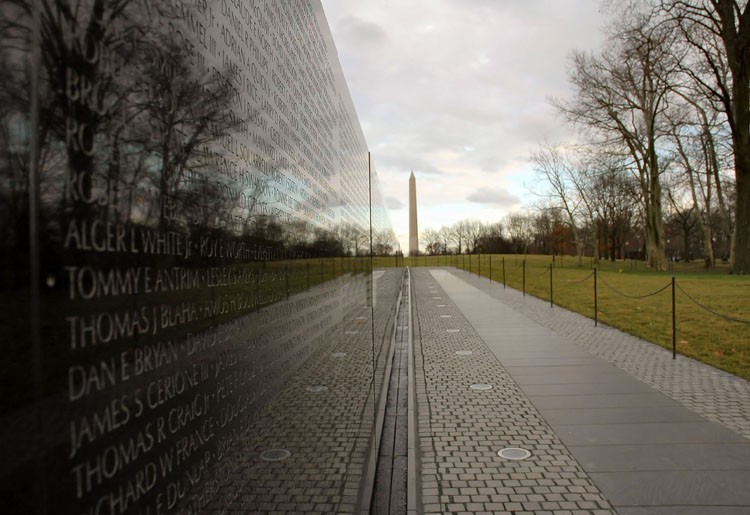
But "hallowed" ground has also meant places like the Vietnam War Memorial Wall in Washington, DC. One of the most profound encounters I have ever had with Grace and Peace happened here. I had gone to DC on a work trip, only a few days in length. Knowing that this might be the only time I ever got the chance to visit our capitol, I decided to get out at least one day and see some of the monuments. I walked from my hotel to the national mall and saw the Washington Monument. From there I walked along the park past the reflecting pool to the Lincoln Memorial. While both are impressive, it wasn't until I walked back along the reflecting pool and took the turn out to walk along Constitution Ave that I really understood what a memorial could do.
Coming in along Constitution, you see the Wall immediately, but coming the way that I did, it sneaks up on you. All of a sudden you're presented with the massive edifice of the two gabbro slabs. Gradually it strikes you that there is something etched into the smooth greenish-black stone. At first you can't quite make it out. But, little by little, as though it takes your mind a moment to grasp the gravity of what you're viewing, you begin to notice the names, fifty-eight thousand names of the men and women lost to that tragic war.
And yet, once I had dealt with the momentousness of the sense of epic impotence I felt at seeing these names, I felt a profound sense of peace come over me. There loss can never be minimized, should never be forgotten, but they are given their moment in history, they are eulogized with moment and respect by that wall. It was one of the most moving things I have ever seen.
It is, I think, the last two verses of this hymn that I find most thought provoking. "This at least we must believe, what we take most earnestly is our living Deity. Our true God we there shall find in what claims our heart and mind..."
What is it we take most earnestly? Money? Power? Education? Television? Our Western, first-world, lives are filled with things that call us away from what philosophers have called our "spark of Divinity". This too then, is or should become a central focus of my spiritual practice: to focus on where it is that I find the "divine" (for lack of a better word), humanity. I think I need, I think we ALL need, to focus on that which binds us, one to another, to focus on reaching out to others to build bridges of love.
The Associate Minister of Music at VUU, Kellie Walker, introduced me to a wonderful, easy to sing, anthem of humanity. The words are:
I'm gonna lift my sister (brother, mother, father, etc.) up
She is not heavy
I'm gonna lift my sister up
She is not heavy
I'm gonna lift my sister up
She is not heavy
If I don't lift her up
I will fall down...
There, there is the crux of my religion in a single phrase...
Friday, August 3, 2012
#1 May Nothing Evil Cross This Door
This lovely tune is the first hymn in the UUA hymnal, Singing the Living Tradition (StLT). I think it is very fitting from a spiritual, or rather, a ritualism perspective that this is the first hymn. It invokes the circle if you will, asking the universe for guidance and protection for what is to come. It builds from that invocation to statements of intent describing the purpose of the gathering and the hoped for outcomes. A fine invocation and a fitting beginning to my journey through the Living Tradition.
The first statement of intent is in the second verse: "by faith made strong, the rafters will..." Religion, at its best, calls us to live a life of deepening faith. We are called to strengthen faith's foundation so that through all the storms of life, though they may batter and shake our walls, the fire of our commitment will remain a living ember within our hearts that should "all the world grow chill" we remain warmed and can share that warmth with others through our love and our actions.
But, I have trouble with that word: "faith". As I have mentioned before, I consider myself a Humanist. I don't believe in a God per se, at least not a personal God. I believe that if there is a manifest God we are her. Whatever good that may happen in the world, or, for that matter, whatever evil, that others might ascribe to God happens at the hand of mankind. Thou are God - grok it.
The idea of faith seems to me to be an invitation to turn off one's intellect and accept, without proof. That seems not only dangerous but perhaps even negligent. Accepting things on blind faith leads to things like the Salem witch trials, the ravages of the church in "frontier" nations, the Jamestown massacre and suicide bombings to name just a few.
So, although I do feel called to live a life of deepening faith, my faith is not in a higher power but instead rests on what I perceive to be an inherent "goodness" in humankind (perhaps I will tackle what I mean by "goodness" in a future post). I have faith that, when given the opportunity and barring hardships such as poverty and ignorance, the "goodness" will win out over the "evil" in our natures and in society at large. I find that the faith I need to depend upon is a faith in humanity, both individually and as a whole. I need faith that each day we recognize more and more our undeniable interconnectedness, and that some day, hopefully very soon, we will come to recognize as a species that we are all one and that "inasmuch as ye have done it unto one of the least of these my brethren, ye have done it unto me."
The second statement of intent, in the third verse, speaks to what the Rev. Dr. Earl K Holt III, interim minister of my spiritual home Valley Unitarian Universalist Congregation, spoke of in the blessing with which he ended each of his services. The blessing included the phrase from Philippians: "the peace that passeth all understanding"...
I have felt that peace only a few times in my life, a sense that all is right with the world and with me, a feeling of wholeness and simplicity so strong that I cannot mistake it. These are the times I've come closest to what others would call a spiritual experience. One example in particular comes to mind.
When I was young I was heavily involved in a Methodist church in my home town. During the summer of my 15th year, an older couple, leaders in the church, asked me if I would like to come with them on their annual camping trip to Michigan's Upper Peninsula. It was my first experience with real camping and is still one of my most treasured memories. During that trip we made the 10 mile hike along the Pictured Rocks National Lake Shore, a breath taking trail along cliffs above Lake Superior.
At one point we came to the heights above Grand Portal Point and found it shrouded in a fog so thick that, to my adolescent and city-bred mind, it seemed as though we were walking through a cloud. We stopped there to eat our lunch before resuming the hike back to our camp ground. While we were eating, encased in white, the sounds of the surf below us and the raucous calls of gulls from a nearby rookery on the cliffs came to us, muted by the fog. For just a brief moment, I felt as though that was exactly where I was supposed to be. It seemed like all my life had been leading to that moment, there on those rocks, so that I could experience the beauty of nature in a way I was sure no one else ever had.
Perhaps that is another goal of maintaining a spiritual practice: finding the "peace that passeth all understanding". It may be that through that peace we can find the faith called out in the second verse.
The last verse seems to be a call to action of a sort. "With laughter drown the raucous shout". With laughter, with joy, we keep the wolves at bay. With laughter we can even "fake it 'til we make it". It often seems to me that we find joy not by looking for it but by being joyful, as strange as that sounds.
I once gave a sermon about happiness called the Happiness Habit. In it I related a story about going in each day to a job I hated with a false smile plastered on my face and that, strangely, by the time I got to work that false smile had become real. I found through that silly, simple action of faking myself out a small measure of the happiness I was seeking found me. It may be that by greeting life with joy, joy finds us.
Perhaps I will never find a faith like that which others, usually Christians, claim to have. It may be that I will never find the "peace that passeth all understanding". But, as a dear friend who collects oddball quotes is fond of saying: "you should always reach for the stars, at least you won't end up with a handful of mud."
How do you get to Carnegie Hall?
How do you get to "heaven"?
Of Hymns and Humanism
The third and fourth principles of our Unitarian Universalist covenant between congregations call respectively to affirm and promote "acceptance of one another and encouragement to spiritual growth in our congregations" and "a free and responsible search for truth and meaning". Unitarian Universalism isn't a faith where you can believe anything you want to as some people would have you think. Rather, it is a faith that requires you to constantly question what it is that you believe, to hold your truth up to the bright light of discernment and actively look for it's flaws. Unitarian Universalism is a faith that requires practice, spiritual practice.
That is hard for someone who identifies as a non-theist. I don't meditate or pray. I don't write daily or even weekly but only as the mood strikes me. I would find it hard to identify any activity in my life that I would call a spiritual "practice". And yet, I find that I want one.
Since I found UUism I have felt called to deepen my exploration of my Humanist values in a spiritual context. To gain a greater understanding of how the inherent goodness I see in humankind can inform my worldview and help me to live a more fulfilling and connected life.
Singing the Living Tradition (StLT) is the official hymnal of the Unitarian Universalist Association of Congregations. Although there is no defining doctrine or creed that binds us, these songs, many derived from our Unitarian and Universalist Christian roots may come closest to being such a common prayer book. So, that is where I am going to start.
I am committing to a minimum of a weekly post looking at the hymns within StLT. I hope that this will spur even more writing than a weekly post, but I will hold myself to at least a post a week. I hope that those reading this will enjoy the journey with me and will hold me accountable to my spiritual growth.
Please feel free to comment, challenge, and in all other ways prod me to better articulate and define what it is that I hold to be true. I hope you can find some truth along the way yourself.
Monday, July 16, 2012
Bumbling Our Way to Beauty
Monday, January 2, 2012
Yesterday was the beginning of a new near, an opportunity to take a pause from the rush of our work-a-day lives and catch our breath, a time to reflect on the successes and failures of the passing year. Not so that we obsess on our shortcomings more to allow us to take stock of those areas in our lives that would benefit from greater attention. Our home lives, our work lives, our congregation life, our inner life - all of these are areas to which we "should" be devoting time and attention. Each can potentially be made better through a focused concentration and forethought on what it is we want from them.
I don’t pretend to be a marriage counselor or a life coach. But, I hope that as a Unitarian Universalist I can take seriously the third Unitarian Universalist Principle of “acceptance of one another and encouragement to spiritual growth in our congregations”. So, that’s what this essay/homily is all about: the tenets of my liberal faith as embodied in our seven Principles. For those of you who, like me, are new to Unitarian Universalism, unfamilliar with the Seven Principles, or, also like me, are getting a little long in the tooth and somewhat forgetful you can find the Seven Principles on the UUA website at uua.org/beliefs/principles/index.shtml.
As a UU minister with whom I am a Facebook friend said in a recent post, the Principles are not a covenant of faith nor could they really be called a theology in and of themselves. The Principles are instead a set of guidelines, ideals of right relation to ourselves, our congregation and the world around us. And as Rob Smith and Dipak Panchal, the co-chairs of the Standing on the Side of Love team at Valley Unitarian Universalist Congregation (www.vuu.org/ssl), wrote in an article in the congregation's December 2011 newsletter, these Principles, all of them, are rife with contradiction or rather with paradox.
To quote that article in part: “it is in these very paradoxes that true power for growth and forward movement lie”. They go on with the example of the First Principle, our affirmation and promotion of the inherent worth and dignity of every person, saying that through this Principle “we are simultaneously asked to believe two things: that we are called toward unconditional love for others and, that we are to have that same unconditional love for ourselves.”
This is a difficult challenge, to love others as you love yourself... It seems to me I’ve heard that phrase before somewhere...
Many of us are really good at sharing and showing our love for others. Our partners, our children and our friends know beyond knowing that we love them. We’re able to show the love of others to the stranger on the bus, the waiter at the restaurant and even to those with whom we disagree but we’re not so good at the loving ourselves part. Self love sounds just a little too much like self important or self centered.
We give others of our time and effort but we pay little heed to taking the time to meet our own needs. Time enough to read that book, time enough to get some exercise, time enough to take that class we’ve always wanted to take, time enough for self reflection and spiritual practice, time enough for a walk in the park, or a hike on the mountain, or a run alongside the canal. As my favorite author put it in in the title of his seminal work, “Time Enough For Love”. Self love.
Perhaps, like me, you often spend too much time idle and leave the little things to build, one sock on the floor becomes a pile of clothes at the bedside, one day without skimming the pool becomes a weekend without skimming and the pool becomes a close approximation of leaf stew...this too is a form of denial of self, as contradictory as that seems. We really do feel better about our world and about ourselves when the environment we inhabit is well tended, and not seeing to that need is just another way to deny your love to yourself, at least, I think, it is for me.
Our second UU Principle calling us to justice, equity and compassion in human relations again presents us with a paradox, does “in human relations” mean when in direct relationship person to person, or does in mean in all relations? Plus there’s the whole “how-well-do-i-know-that person-and-how-well-do-I-like-them” dilemma. I know that I find it much easier to engage with compassion toward those with whom I agree than those with whom I passionately disagree. I think there’s a little bit of human nature in that, sadly. An example that comes to mind is the tragedy that recently befell the Duggar family.
For those who don’t know them, the Duggars have a reality show called “18 Kids And Counting” that airs on TLC. The Duggars have a deeply held religious belief in the sanctity of children. As Michelle, the mother, puts it: “saying there are too many children is like saying there are too many flowers”. So strong is that belief that their family now numbers 19 children. To them every child born is a blessing from God and a testament to his Grace. Contraception, therefore, is blocking the will of God and something they will not use. Although I deeply disagree with them and there are a great many studies that show that the quickest way to eliminate poverty and suffering in the world is to give women control over their reproductive freedom, the Duggars hold childbirth and child rearing as a sacrament. So, imagine their grief when, in early December of 2011, Michelle miscarried their 20th child. Heart stricken and grieving the Duggars named their unborn daughter Jubilee Shalom Duggar and held a memorial service on December 14th.
In most cases the news reports were less than kind and online commentary from the public was brutal to say the least. Comments ranged from “having 19 children is criminal” to “what did they expect” to “this is God’s way of telling them to stop having children” and worse. Not all the comments were this heartless but most were.
I tell this story to emphasize that compassion for many people, I might even hazard most, depends both on proximity and on agreement. And that justice and equity are often built upon our own biases. That’s certainly been my struggle with this particular Principle in the past year and I imagine it will be my struggle in the coming year as well: understanding how my own biases and privilege as a white, heterosexual, upper-middle-class man influence what I consider justice and equity and finding compassion in my heart for everyone in the family of humankind both known to me and unknown.
Our third Principle: acceptance of one another and encouragement to spiritual growth, is as challenging as the first two. Is acceptance in this sense related solely to someone's spirituality? And what defines spiritual growth? I think this is especially difficult for a faith without creed or even a coherent and communal theology.
An atheist friend and I had a conversation recently in which I told him that a place like VUU might be just the thing for him, that there were, in fact, many people in our congregation and in UU congregations around the country who identify as non-theist or even atheist. In the study our search committee did last September fifty-nine percent of our congregation listed Humanism as their spiritual identity. That’s fairly consistent with UU congregations around the country. So, an atheist would likely feel quite comfortable in our company.
But not this particular atheist. For him, rationality is his “religion” (note: those are my words, not his). Faith in a higher power, or in anything outside the realm of direct human experience and unprovable through empirical evidence is giving one’s self over to irrationality which, in his mind, is unacceptable. His question to me was “isn’t one of your Principle’s an acceptance of another person’s spiritual path and an encouragement to their spiritual growth?” Of course I answered yes. “Well then”, he said, “that counts me out.” Not only would he have had a hard time “accepting” someone's desire to forgo rationality in favor of magical thinking but he couldn’t imagine encouraging such a thing.
Another UU friend of mine had a different take on it in a recent Facebook post. She said: “As a UU I know what I believe and can tell folks in 2 or 3 sentences. I can also tell folks succinctly what our Unitarian and Universalist ancestors believed. But when people ask me what UUs believe today I invariably end up hemming and hawing and rambling out something semi-academic and utterly uninspiring.”
Reverend Peter Boulatta, a UU minister in Minnesota, might have said it better in a post on his blog (http://bit.ly/tAgovp): “...many thoughtful UUs (talk) about our creedless religion, our covenanted communities in which one is free to search for truth and meaning. It’s likely that thoughtful UUs (explain) being gathered around basic principles and values rather than beliefs and doctrines. But what (people hear is): We don’t believe anything. We’re just making this stuff up as we go along to suit ourselves.”
Now while that might be true for many, it doesn’t have to be. The UUA and VUU have a great set of tools to help congregants come into a deeper understanding of their own spiritual truth. One of those is a class called “Building Your Own Theology”. But that class is just a start, and we have ongoing work to do as individuals, in covenant together, to grow our spiritual armor and refine our own truths. UUism isn’t a blanket to believe anything you want without examination. In my mind it’s a framework to help guide you along a never ending road of self discovery and moral development.
I wonder if we do too little encouraging and too much accepting...
The fourth UU Principle says we affirm and promote a free and responsible search for truth and meaning. Free and Responsible. We have a right to a community of peers that won’t tell us what the One Real Truth is, and we expect that. But, with that right comes a responsibility to own the truth to which we come, to own the defense of that truth, to constantly test it, distill it, filter and refine it to ensure that it is in fact a real truth and not a convenient hat rack on which we hang our preconceptions. And, with that right also comes another responsibility, to hold each other accountable for taking that journey and finding that truth. After all, right there in the the covenant of our congregation, printed in our order of service every week, we say that the quest for truth is oursacrament...our sacrament...our sign of inner grace...our thing of sacred character.
A religion, any real or meaningful religion, should give us a frame of reference that informs our lives in a positive way, that helps us be better people, more loving people, more grounded people, kinder, more compassionate people. We owe it to each other to hold ourselves up to the light of discernment and to challenge others to hold themselves up to that same light.
If the other Principles are rife with paradox, the fifth UU Principle is a Gordian knot. To go back to the newsletter article from the SSL@VUU co-chairs "“the right of conscience and the use of the democratic process within our congregations and in society at large” ...includes both the importance of democracy and the right of conscience. The tension in that statement, between the value of individual thought and action and the value of group consensus, is similar to the tension between the value of talking and the value of listening. Both are important, but they stand in fundamental opposition. We cannot do both at the same time. Which should we do more?”
UUs believe, and rightly so, in the precept of congregational polity. Each congregation is a petri-dish of democracy in action but it’s a democracy where each person is encouraged to find their own personal truth. We are all acknowledged to have a right of conscience - we can abstain, absent, disagree, and in all other ways advocate our own position but at the end of the day we take a vote and majority rules. Even among our congregation's board and the UUA board in the end, we vote. And voting takes time... a LOT of time...
So, we’re called to take action in the world but constrained by the democratic process from moving quickly. We’re asked to come to agreement through polity but we come with our own truth. It’s a wonder that buildings stay standing and we somehow have services every Sunday!
Our sixth Principle leads us toward the goal of world community with peace, liberty and justice for all. Well...we talked earlier about justice and its subjective nature. Here, in America, we call killing in the name of punishing killers "just". In Afghanistan they call caning a women who refused to marry her rapist just. In France they use a Napoleonic system of justice - guilty until proven Innocent.
I often wonder if my donations to Amnesty International or Amfar or the Unitarian Universalist Service Committee will ever do more than move us just a little farther toward a peaceful world. Still, I’m optimistic in my cynicism. As Dr. King said: the arc of the moral universe is long but it bends toward justice. And so, I’ll continue to do my small part, to learn about the world so that it becomes a little smaller, to use my privilege to make the opportunities for others a little bigger and I’ll continue to hope that, together, our efforts bend the arc a little farther.
The last of our UU Principles says that we "affirm and promote respect for the interdependent web of all existence of which we are a part". Affirm and Promote - I really worry that although we affirm this loudly, we promote it softly. I see the world we are creating when, every day, the food we eat and the goods we purchase are packaged for mass consumption and I worry about the coming-of-uppance humanity faces on the near and immediate horizon where sea levels and global temperatures rise while clean living spaces and arable land shrink. Are the small changes we make in our own lives: recycling, driving a hybrid, composting, reusing and re-purposing enough to change the tide? I’m not so sure. But I am sure there’s more that we can do.
So where is the paradox in this Principle? Where is the tension? Well, I’m still working on this one. Perhaps, I need to attend a few Green Sanctuary meetings...I’ll try to work that in to my schedule this year...
Our Unitarian Universalist Principles, or at least most of our Principles, are filled with paradox. But, such is everything in life. By facing that paradox we come away strengthened in our understanding and so the choices we make moving forward are better informed and hopefully better in affect.
I said at the outset that the New Year was a time of reflection and renewal. It’s a time where we examine the past and plan for the future. It’s a time when we pause and take stock, where we try, if only for a short time, to gain clarity. So, I leave you with a charge. Take time this month, perhaps even this week to think about your own truths, your own spiritual path, whatever that may be.
As you think about what you want from the coming year in your career, your relationships, your family life, think too about your growth in spirit. How will you grow your understanding and enrich your way of being in the world? And how will this new year be different for you on that spiritual sojourn? Perhaps, as I do, you can use the UU Principles as guideposts on the walk. And remember as you stumble along your path that even if you fall, you can always begin again. And you don't even have to wait for New Year's Day to do it!
I wish you light and love. Blessed Be.